
7. Papua New Guinea – Eastern Highlands
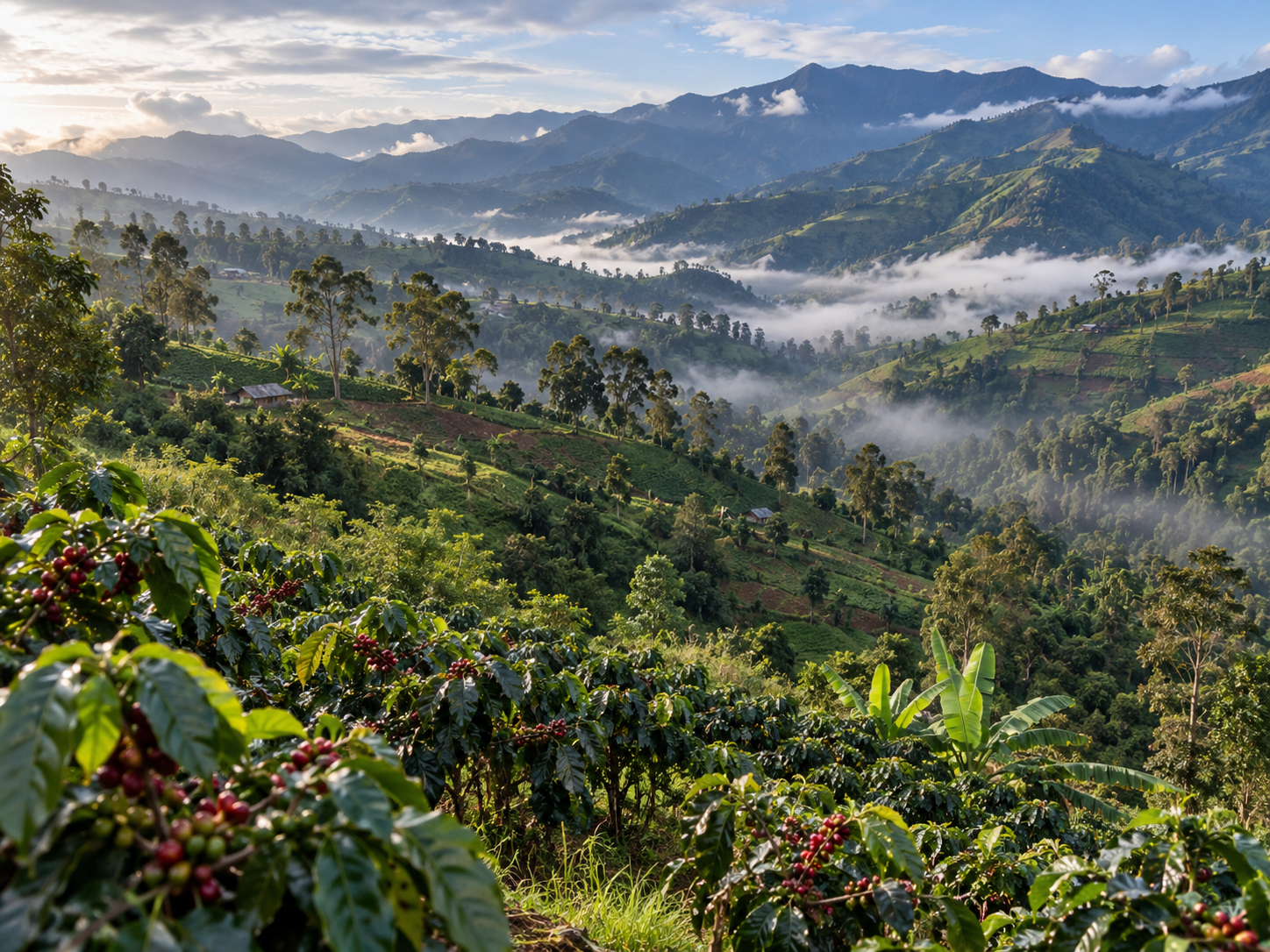
Deep in Papua New Guinea’s Eastern Highlands around Goroka, coffee is grown across remote valleys and mountain communities.
This Typica coffee grows between approximately 1,500 and 1,800 metres above sea level, where cooler highland temperatures help coffee cherries mature more slowly.
What makes the production system particularly interesting is its scale. Rather than one large plantation, the coffee is grown predominantly by very small family farms, with individual plots averaging around just 0.7 hectares.
Around 95% of production in the area comes from smallholders.
The landscape creates significant logistical challenges. Many farming communities are distant from larger towns and have limited road access, so farmers carry out the first stages of processing locally.
Freshly harvested cherries are washed and processed into parchment coffee before being sold through village traders. From there, the coffee travels to a dry mill where the parchment is removed and the beans are cleaned, sorted and graded.
Eventually, the coffee travels to the port of Lae before beginning its international journey.
Papua New Guinea’s coffee industry has gradually shifted away from the plantation based production that once dominated. More recently, the country’s Coffee Industry Corporation has also placed greater emphasis on quality in the cup, rather than judging coffee primarily by bean size and physical appearance. This creates more opportunity for well produced smallholder coffee to receive recognition for its actual flavour.